


Finally! Touchnote goes awesome
John Gruber recently highlighted Google searches for “finally” and “iOS5”. It seems a lot of people think iOS has now hit a point where it has matured into a really solid platform.
I’ve been using the new version of Touchnote’s iPhone app – out later today – and I feel exactly the same. All the niggles that I complained about before have been worked out.
If you’re not aware of Touchnote, it allows you to send postcards – real, physical ones, not eCards – using photos from your iPhone. I loved the idea when the Touchnote app came out in 2009, and used it to send a few cards on holiday.
The Guardian’s new iPhone app is out
I use the original everyday. Good things they’ve introduced:
- Landscape mode
- Twitter posting
- “A new football scores service with free goal alerts by team and match for the main UK leagues and European competitions” (yay!)
Not so good: it’s now subscription-based. £2.99 for 6 months or £3.99 for a year. But let’s face it, the old app’s model of a one-off £2.39 was never going to work, was it?
The original Guardian app will work for another 6 months, so you have a while to decide.
You can now unlock your iPhone 4 from O2 and Orange
 With a quick chat and an email, reader Xavier managed to get his iPhone 4 unlocked from O2. There’s nothing special about his contract, and he isn’t an O2 employee or anything like that. And it seems that you can get your iPhone 4 unlocked from Orange as well, although reports are it can be a bit torturous. Here’s how it happened.
App giveaway: CoPilot Live satnav
 At the start of the year I reviewed CoPilot Live for UK and Ireland from ALK Technologies.
It’s my first choice of satnav app, and I’m happy to promote it as I think it’s worth your cash. It has also just been updated with the latest NAVTEQ maps and safety camera data.
And lucky you, Santa has brought TEN copies of the app for me to give away!
iPlayer can’t be streamed via AirPlay – or can it?
 In September I was all excited about streaming BBC iPlayer content from an iPhone or iPad to the new Apple TV, based on the fact that AirPlay allows:
Any H.264 content from the web can be broadcast over Airplay to your HDTV.
Except that now iOS 4.2 has been released, it doesn’t work that way. Only audio can be streamed from non-Apple apps, which is frankly rubbish.
But there may be a solution.
Once again, jailbreaking to the rescue!
This is only a small thing, but it reinforces for me why jailbreaking an iOS device allows you so much more flexibility in using your gadget.
iOS 4.2 for iPad has been out for 3 days. One small gripe is that Apple – in their wisdom and wish for unity across their range of devices – has decided to change the orientation lock on the iPad into a mute switch. I know this makes it operate in the same way as the iPhone, but I don’t use my iPad in the same way as my iPhone. The orientation lock makes sense – and if you want to mute an iPad quickly, you can just hold the volume decrease button, and volume will drop to zero immediately.
But 3 days later, we have a solution. There’s a jailbreak for iOS 4.2.1, and Nicolas Haunold has today released a simple tweak through Cydia called NoMute, which changes the function of the mute switch under iOS 4.2 back to being an orientation switch.
A small, simple thing that demonstrates why people need to be legally allowed to hack their gadgets – to make them work in the way that they want.
Undeleting iPhone photos, or anything else
I’m starting to post more stuff that I come across that I think will be interesting to All About iPhone’s readers, such as this. If you happen to delete photos – or any other data – on your iPhone that you want to recover, then you can try this method:
http://modmyi.com/forums/file-mods/237321-how-iphone-data-recovery.html
It works because data on the iPhone’s disk (as with any other computer) is still present until it gets overwritten. When you “delete” a photo, only the reference to that photo file is actually removed. You can then use a photo recovery tool, as with any other disk. Personally, I’ve always found PhotoRescue to be superb at recovering photos.
This method does require an iPhone that has been jailbroken prior to you deleting the data you want to recover. But because you get a disk image of your entire phone, you could recover any data from it, as long as it hasn’t already been overwritten, and you know where to look.
DataMan
Let’s face it, iOS devices have pretty crappy built-in data tracking. Settings –> General –> Usage gives you this mightily useful piece of information.
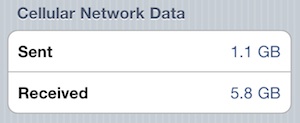
Enter DataMan. It uses location services to determine where and when you use wifi and mobile data; you don’t have to keep it running in the background, by the way.
The app gives you local notifications when you hit daily, weekly and monthly limits, based on percentage of allowance thresholds you set. A really good idea if you’re not on an unlimited data plan.
In keeping with my policy of not writing about things when they’ve been perfectly well covered elsewhere, take a look at Craig Thornton’s review of DataMan if you’d like to know more.
Improvements
There are two additional things I’d like to see, or rather remove:
- Daily and Weekly notifications
- Two of the four percentage usage notifications
I don’t need to be notified that much about my data. Saying that, you can work around those by setting daily and weekly allowances to the same as the monthly allowance, and percentage usage alerts to above 100%. But the developer has also told me that options to turn some things off is en route. Actually, I’ve just noticed that DataMan Lite only has the monthly usage, so if that’s all you need, give that a go.
I’ve also come across an app called Download Meter that does the same sort of thing – I haven’t tried it, but here’s the iTunes link.
Confused about unlocking your iPhone?
This one is for jailbreakers only:
If you’re trying to unofficially unlock your iPhone, there are lots of guides around. I’d recommend the unlocking tutorials at iClarified, in particular. But it can be confusing.
I like sites that cut through the cruft, and I’ve just found out about Can I Unlock My iPhone?
It’s up-to-date with current jailbreak and unlock developments, and gives you a simple answer, based on your iOS device and firmware.
If you’re looking for an official unlock from your UK mobile phone network, then I’ve previously written about that (but it needs to updated for iPhone 4).